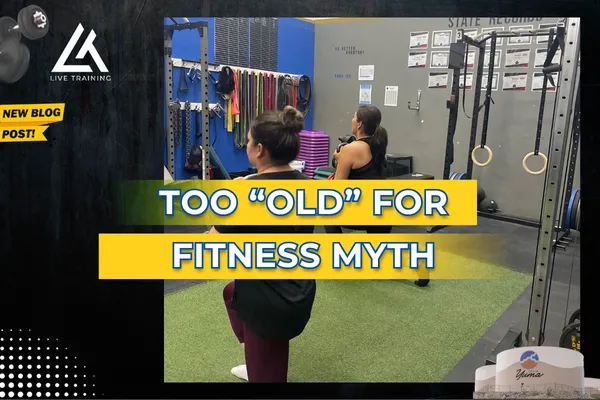
18. It’s Not Too Late. It’s Just a Different Starting Line
It’s Not Too Late. It’s Just a Different Starting Line.
Why age was never the barrier—and why the best time to invest in your body is the one you’re living in right now.
──────────────────────────────────────────────────
There’s a thought that creeps in quietly. It doesn’t show up all at once. It builds slowly—every time you see someone younger in the gym, every time you feel a twinge in your knee getting out of the car, every time you catch your reflection and think about who you used to be.
The thought sounds something like this: “I’m too old for this.”
Maybe you don’t say it out loud. Maybe it’s more of a feeling—a quiet resignation that the window has closed. That fitness is a young person’s game. That at 45, or 52, or 60, the best you can hope for is to not get worse.
I want to challenge that. Because it’s one of the most damaging beliefs I see in the people who walk through our doors. And it’s also one of the most wrong.
Where This Belief Comes From
You didn’t make this up on your own. This belief was built for you—by an industry that has spent decades telling you what fitness is supposed to look like.
Fitness media shows 25-year-olds with six-packs. Fitness ads promise 90-day transformations. Fitness culture worships intensity—heavier, faster, harder, more. And when your body doesn’t match that image and your joints don’t cooperate with that pace, the conclusion feels obvious: this isn’t for me anymore.
But that conclusion is based on a definition of fitness that was never accurate in the first place. Fitness was never supposed to be about how you look at the beach. It was supposed to be about how you live your life.
And your life? It’s not over. Not even close.
What Fitness Actually Means After 40
Here’s what nobody in the fitness industry wants to talk about: the goals change as you age. And that’s not a limitation—it’s a gift.
In your 20s, maybe fitness was about aesthetics. In your 30s, it was about keeping up. But in your 40s, 50s, and beyond? Fitness becomes about something much more meaningful. It becomes about quality of life.
It’s about being able to play on the floor with your grandkids and get back up without help. It’s about traveling without worrying whether your back can handle the flight. It’s about walking through a grocery store, carrying your own bags, climbing your own stairs—without pain, without fear, without depending on someone else.
That’s not a lesser goal. That’s the whole point.
Your Body Didn’t Quit on You. It Adapted to What You Gave It.
When people say they feel “old,” what they usually mean is they feel stiff, weak, or tired. And while age plays a role, it’s rarely the main character in that story.
The stiffness? That’s from years of sitting more and moving less. The weakness? That’s from muscle loss that happens when you stop challenging your body. The fatigue? That’s often a combination of poor sleep, stress, and a metabolism that’s slowed down because it hasn’t been asked to work.
None of those things are permanent. None of them are inevitable. Your body didn’t give up on you. It adapted to what you gave it—which, for most people in their 40s and 50s, has been a desk, a couch, and a lot of good intentions that never turned into action.
The encouraging news? Your body adapts in the other direction too. Give it movement, and it moves better. Give it resistance, and it gets stronger. Give it consistency, and it starts to trust you again.
The People Who Inspire Me Most Started Late
I’ve worked with people who started training at 48 and told me they feel better now than they did at 35. I’ve watched someone with chronic knee pain go from dreading stairs to hiking with their family. I’ve seen people in their 50s build real, measurable strength—not in spite of their age, but because they finally found a program that respected it.
These weren’t athletes. They weren’t “fit people.” They were regular adults who had spent years believing the lie that it was too late. And then they decided to test that belief.
Here’s what they’d tell you if they could:
“I wish I hadn’t waited so long. But I’m glad I didn’t wait any longer.”
“I thought I’d feel out of place. Instead, I felt seen.”
“For the first time in years, I actually trust my body again.”
“I’m not trying to look 25. I’m trying to feel alive. And I do.”
Every one of those people had the same doubt you might be carrying right now. And every one of them proved it wrong.
The Right Program Doesn’t Ignore Your Age. It Respects It.
The problem with most fitness programs isn’t that they’re bad. It’s that they’re designed for a version of you that doesn’t exist anymore—or maybe never did.
A program built for someone in their 40s or 50s looks different. It starts with a conversation, not a workout. It asks about your pain, your history, your daily life. It accounts for the shoulder that flares up, the lower back that tightens, the knee that’s been “fine” for years but isn’t really fine.
It prioritizes movement quality over movement quantity. It builds strength without breaking you down. It progresses at your pace—not the pace of some generic 12-week challenge that was written for someone half your age.
That’s what semi-private training is designed to do. Small groups. Real coaching. A program that’s yours—not a template. An environment where being 50 isn’t a disadvantage. It’s just where you are. And where you are is a perfectly good place to start.
You Have a Whole Life Ahead of You
I say this to people all the time, and I mean it every time: you have a whole life ahead of you.
Not a diminished life. Not a “just getting by” life. A real, full, active life where you get to decide how your body feels, how you move, and what you’re capable of.
Age didn’t close the window. It just changed the view. And if you’re willing to look through it—willing to walk through the door one more time—you might be surprised by what’s on the other side.
You’re not too old. You’re not too far gone. You’re not too late. You’re just standing at a different starting line. And that’s still a starting line.
Curious What Your Starting Line Looks Like?
If you’ve been putting this off because you thought the opportunity had passed, I’d love to have a conversation with you. No workout. No pressure. Just a real talk about where you are and what’s possible from here.
We call it a Starting Point Session. It’s free, it’s personal, and it’s designed for people exactly like you—people who want to feel better but aren’t sure where to begin.
And if it’s not the right fit? We’ll shake hands and part friends.
Because the best time to start was years ago. The second best time is today.
