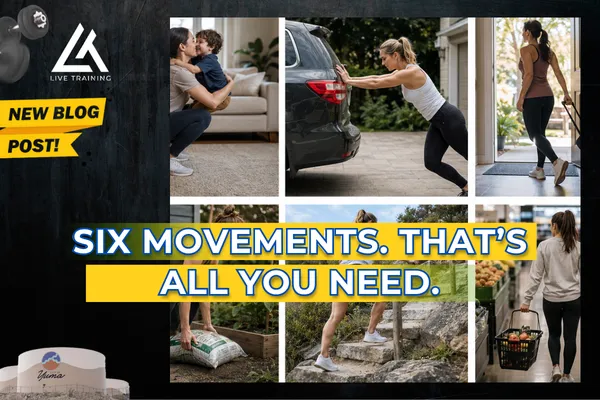
23. Six Movements. That’s All You Need
Six Movements. That’s All You Need.
The six foundational movement patterns your body was built for and why we train every single one of them, every single week.
──────────────────────────────────────────────────
Fitness can feel complicated. Scroll through social media for five minutes and you’ll see a hundred different exercises, machines, and techniques—each one claiming to be the thing your program is missing.
But here’s something the fitness industry rarely tells you: your body doesn’t need a hundred exercises. It needs six movements.
Squat. Hinge. Lunge. Push. Pull. Carry.
That’s it. Every functional thing your body does in the real world—every time you pick something up, climb stairs, push a door open, carry groceries—falls into one of these six patterns. They’re not gym exercises. They’re human movements. And when you train them well, everything else falls into place.
At Live Training, these six movements are the foundation of every program we write. Every member, every week, every session—all six are covered. Not because it’s simple. Because it’s what works.
1. Squat
The Movement:
Bending at the knees and hips to lower your body, then standing back up. Think: sitting down and standing up from a chair.
Where You Use It in Real Life:
Picking up your kids or grandkids from the floor. Getting in and out of a car. Sitting down on a low couch and standing back up without using the armrests. Using the restroom. Getting out of bed. You squat dozens of times a day—you just don’t call it that.
Why It Matters:
The squat is the most fundamental lower body movement there is. It builds the quads, glutes, and core strength that keep you independent as you age. When people lose the ability to squat properly—to sit down and stand up under control—that’s when daily life starts requiring assistance. Training the squat keeps that from happening.
2. Hinge
The Movement:
Bending forward at the hips while keeping your back straight, then driving your hips forward to stand tall. Think: a deadlift, a kettlebell swing, or bending over to pick something up off the ground.
Where You Use It in Real Life:
Picking up something heavy from the floor—a suitcase, a bag of dog food, a toddler. Bending forward to load the dishwasher. Grabbing something from a low shelf. Every time you bend forward and lift, you’re hinging. And if you don’t know how to hinge properly, your lower back pays the price.
Why It Matters:
The hinge builds the entire back side of your body—your hamstrings, glutes, and the muscles that protect your spine. Most lower back pain in adults over 40 comes from a weak or poorly coordinated hinge pattern. Train the hinge, and you’re not just getting stronger—you’re protecting your back every time you bend over for the rest of your life.
3. Lunge
The Movement:
Stepping forward, backward, or to the side and lowering your body on a single leg. Think: a forward lunge, a reverse lunge, or a step-up.
Where You Use It in Real Life:
Walking up stairs. Hiking on uneven terrain. Stepping over something on the ground. Getting down on one knee to tie your shoe or talk to a child. Any time your legs work one at a time—which is most of the time, if you think about it—you’re lunging.
Why It Matters:
Life doesn’t happen on two legs at the same time. Walking, climbing, stepping—these are all single-leg activities. The lunge builds single-leg strength, balance, and hip stability that directly transfers to how you move through the real world. It also exposes imbalances between your left and right side—imbalances that, left unchecked, lead to compensation and eventually pain.
4. Push
The Movement:
Pressing something away from your body—horizontally (like a chest press) or vertically (like an overhead press).
Where You Use It in Real Life:
Pushing a heavy door open. Pushing your car if it breaks down. Pushing yourself up off the floor. Putting a suitcase in the overhead bin. Loading boxes onto a high shelf. Any time you need to move something away from your body or press yourself up, you’re using the push pattern.
Why It Matters:
The push builds your chest, shoulders, and triceps—but more importantly, it builds the upper body pressing strength you need to interact with the world around you. As people age, upper body strength declines faster than lower body strength. Training the push pattern keeps you capable of doing the things most people take for granted until they can’t do them anymore.
5. Pull
The Movement:
Drawing something toward your body—horizontally (like a row) or vertically (like a pull-down).
Where You Use It in Real Life:
Opening a heavy door. Pulling a suitcase off a conveyor belt. Starting a lawnmower. Pulling yourself up if you slip. Raking the yard. Any time you need to bring something toward you or brace against something moving away, you’re pulling.
Why It Matters:
The pull builds your back, biceps, and grip strength—the muscles that hold you upright, keep your shoulders healthy, and give you the ability to grip, grab, and hold on. Grip strength alone is one of the strongest predictors of longevity. And posture? That’s largely a pulling strength issue. The stronger your pull, the taller you stand and the less your shoulders round forward as you age.
6. Carry
The Movement:
Holding a weight and walking with it—at your sides, at your chest, overhead, or on one side. Think: farmer’s carries, suitcase carries, front-loaded carries.
Where You Use It in Real Life:
Carrying heavy grocery bags from the car to the kitchen. Hauling luggage through an airport. Carrying a sleeping child up the stairs. Moving boxes when you’re reorganizing the garage. Any time you need to hold something heavy and walk with it—which happens constantly in real life—you’re carrying.
Why It Matters:
The carry is the most underrated movement pattern in fitness. It trains your grip, your core, your shoulders, and your entire stabilizing system—all at once, all while moving. It’s the most real-world movement there is, because real life doesn’t ask you to sit on a machine and push a lever. Real life asks you to pick something up and walk with it. The carry prepares you for exactly that.
How We Program All Six, Every Single Week
Here’s how it works at Live Training. We don’t pick random exercises and hope for the best. We start with these six movement patterns as the framework. Then we find the specific variations that fit each individual.
Maybe your knees don’t love a deep squat right now—so we start with a box squat at a height that feels comfortable and progress from there. Maybe your shoulder doesn’t allow overhead pressing yet—so we use an incline press or a landmine press that stays in a pain-free range. Maybe your hinge pattern needs work before we load it heavy—so we start with a hip hinge drill using just bodyweight until the pattern is clean.
The movement pattern stays the same. The variation fits you. And then we progress from right there.
Every week, all six patterns get covered. No exceptions. Because each one of them is too important to skip. Your body doesn’t function in isolated parts—it functions as a system. And these six patterns are how that system stays strong, balanced, and capable.
Why This Approach Beats the Complicated Stuff
You don’t need a complicated program. You don’t need seventeen different bicep variations. You don’t need to “confuse your muscles” or rotate through a new workout every week.
You need six movement patterns, trained consistently, progressed intelligently, and matched to your body. That’s the recipe.
The people who stay consistent for years aren’t the ones doing the flashiest workouts. They’re the ones doing the fundamentals really well—week after week, month after month—and progressing at a pace their body can sustain. That’s how real strength gets built. That’s how real muscle gets built. And that’s how you build a body that serves you for the rest of your life.
Simple doesn’t mean easy. It means intentional. Every movement has a purpose. Every variation is chosen for a reason. And every week, your body gets exactly what it needs to keep moving forward.
You Have a Whole Life Ahead of You
Your body was built to squat, hinge, lunge, push, pull, and carry. These aren’t gym exercises—they’re the movements that make up your life. And training them is how you make sure that life stays full, active, and independent for as long as possible.
You don’t need to train like an athlete. You need to train like a human being who wants to live well. And that starts with the six movements your body already knows—done with intention, coached with care, and progressed at your pace.
──────────────────────────────────────────────────
Want to See How These Six Movements Would Work for Your Body?
If this made you realize your training has been missing something—or if you’ve never trained with a real framework before—I’d love to show you what it looks like in practice.
We call it a Starting Point Session. One conversation about your body, your goals, and how these six foundational movements would be tailored to fit exactly where you are right now.
And if it’s not a fit? We’ll shake hands and part friends.
Because fitness was never supposed to be complicated. It was supposed to be human.
