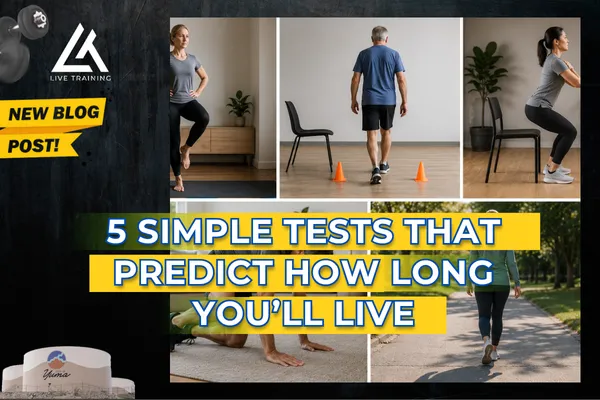
22. Five Simple Tests That Predict How Long You’ll Live
Five Simple Tests That Predict How Long You’ll Live
The five metrics of longevity that have nothing to do with how you look - and everything to do with how you’ll live.
──────────────────────────────────────────────────
When most people think about fitness, they think about how they look. The number on the scale. The size of their waist. Whether their arms look good in a t-shirt.
But the research tells a completely different story about what actually matters.
Over the last two decades, scientists have identified a handful of simple physical tests, things you can do in your living room in under ten minutes, that are among the strongest predictors of how long you’ll live and how well you’ll live. Not blood markers. Not genetics. Not your resting heart rate. Basic physical abilities that most people start losing in their 40s and 50s without even realizing it.
These are the five metrics of longevity. And if you’re over 30, they matter more than almost anything else you could measure about your health.
1. The 10-Second Single Leg Balance
The Test:
Stand on one leg, unsupported, for 10 seconds. No holding onto anything. No bracing against a wall. Just you, one leg, and ten seconds.
What the Research Says:
A landmark study published in the British Journal of Sports Medicine followed over 1,700 adults aged 51 to 75 for more than a decade. The findings were striking: people who could not hold a single leg balance for 10 seconds had an 84% higher risk of death from any cause within the next ten years - even after accounting for age, weight, and other health conditions.
One in five participants failed this test. And the failure rate climbed sharply with age, meaning the older you get, the more critical this ability becomes and the faster you lose it if you’re not actively training it.
Why It Matters:
Balance is one of the first physical abilities to decline with age, and one of the last things people think to train. But balance isn’t just about not falling over. It’s a reflection of your nervous system, your core stability, and the coordination between your muscles and your brain. When balance goes, independence starts to follow.
2. The Timed Up and Go
The Test:
Sit in a standard chair. On “go,” stand up, walk 10 feet, turn around, walk back, and sit down again. Time how long it takes.
What the Research Says:
Taking longer than 10-12 seconds on this test is predictive of increased all-cause mortality and significantly elevated fall risk. In older adults, scores above 12 seconds are associated with a meaningful decline in functional independence, and scores above 20 seconds indicate serious mobility impairment.
Why It Matters:
This test measures something deceptively simple: your ability to get up, move, and sit back down. It’s a snapshot of lower body strength, balance, coordination, and gait speed all in one movement. These are the exact abilities you need to navigate your own home, get in and out of a car, and move through daily life without assistance. When this number starts climbing, your world starts shrinking.
3. The 30-Second Sit to Stand
The Test:
Sit in a chair with your arms crossed over your chest. Stand up and sit back down as many times as you can in 30 seconds.
What the Research Says:
This test is one of the strongest predictors of fall risk in older adults and a reliable measure of functional lower body strength. The benchmark is 12 or more repetitions in 30 seconds. Falling below that number is associated with significantly increased risk of falls, loss of independence, and decline in quality of life.
Why It Matters:
Think about how many times a day you stand up. From a chair. From a couch. From a toilet. From your car. Every single one of those moments requires your legs to produce enough force to lift your bodyweight, quickly, safely, and without help. This test measures exactly that. And for adults over 40, it’s one of the most honest assessments of where your lower body strength actually stands.
4. The Floor to Rise Test (Sitting-Rising Test)
The Test:
From standing, lower yourself to a seated position on the floor. Then stand back up. The test scores you out of 10 total points—5 for sitting down and 5 for rising up. You lose points for using your hands, knees, or the side of your leg for support.
What the Research Says:
In a study of over 2,000 adults aged 51 to 80, participants who scored in the lowest range (0-3 out of 10) had 5 to 6 times the risk of death compared to those who scored in the highest range. Every single-point increase in score was associated with a 21% reduction in mortality risk. Of those who scored a perfect 10, only 3.7% died during the study period, compared to 42.1% in the lowest-scoring group.
Why It Matters:
Getting down to the floor and back up requires strength, flexibility, balance, and coordination working together simultaneously. It’s one of the most complete tests of functional fitness that exists, and it’s something many adults in their 40s and 50s struggle with long before they realize it. If you can’t get down to the floor to play with your grandkids and get back up without grabbing the couch, this test is telling you something important about the direction your body is heading.
5. The Six-Minute Walk Test
The Test:
Walk as far as you can in six minutes on a flat surface at a pace you can sustain. Measure the distance.
What the Research Says:
A healthy adult should be able to cover 500 or more meters (roughly a third of a mile) in six minutes. Distances between 350 and 500 meters indicate reduced functional capacity that warrants attention. Distances below 300 meters are associated with severe functional impairment and significantly increased mortality risk across multiple studies.
Why It Matters:
This test measures your cardiovascular endurance and overall functional capacity in the most practical way possible: walking. Not on a treadmill with an incline. Not with a heart rate monitor and a VO2 max calculation. Just your body, moving through space, for six minutes. It’s the closest thing to a real-world test of whether your heart, lungs, and legs can keep up with the life you want to live, grocery shopping, traveling, keeping up with your family, walking through an airport without needing to stop and rest.
What These Five Tests Are Really Telling You
Notice what’s not on this list. Body fat percentage. Bench press max. Mile time. How you look in the mirror.
The research is clear: the physical abilities that predict how long and how well you’ll live have nothing to do with aesthetics and everything to do with function. Balance. Strength. Mobility. Endurance. The ability to move your own body through space safely and independently.
These are the abilities that decline quietly in your 40s and 50s - so gradually that you don’t notice until one day you realize you can’t stand on one leg without wobbling, or you need to use the armrest to get out of a chair, or getting up from the floor takes three attempts and a piece of furniture.
And here’s the part that should get your attention: every single one of these abilities is trainable. They’re not fixed. They’re not determined by your age. They respond to the right kind of training, the kind that prioritizes movement quality, functional strength, and the specific physical capacities that keep you independent, capable, and alive.
How We Train for Longevity at Live Training
This is exactly what our programming is built around. Not chasing a look. Not training for a sport. Training for a long, capable, pain-free life.
Balance work is built into every session. Single leg movements, stability challenges, and proprioceptive training that keep your nervous system sharp and your balance improving, not declining, as you age.
Functional strength is the foundation. Sit to stand. Floor to rise. Carrying, pushing, pulling, hinging - the movement patterns that directly translate to real life. We don’t train muscles in isolation for aesthetics. We train your body to do the things it needs to do for the next 30, 40, 50 years.
Cardiovascular capacity is woven in. Not through endless treadmill sessions. Through intelligent programming that builds your heart and lungs while you train, so your six-minute walk distance goes up without dedicating entire sessions to cardio you’ll never stick with.
Every program is individualized. Because your starting point on these five metrics is different from anyone else’s. Your balance might be strong but your sit-to-stand might need work. Your endurance might be solid but getting off the floor might be a struggle. We assess, we address, and we build from where you actually are.
You Have a Whole Life Ahead of You
That’s not a motivational phrase. It’s a fact. And these five tests are telling you how much of that life you’ll be able to fully live.
The question isn’t how much you weigh or how you look. The question is: can you stand on one leg for ten seconds? Can you get off the floor without using your hands? Can you stand up from a chair twelve times in thirty seconds?
If the answer is yes, great. Let’s keep it that way. If the answer is no, or you’re not sure—that’s not a death sentence. It’s a starting point. And every one of these metrics can be improved with the right training.
Your body is either getting stronger or getting weaker. There is no standing still. And the work you do, or don’t do, in your 40s and 50s determines which direction you’re heading.
──────────────────────────────────────────────────
Want to Know Where You Stand on These Five Metrics?
If reading this made you curious - or a little uncomfortable - that’s a good sign. It means you care about how you’re going to live, not just how long.
We can assess all five of these in your Starting Point Session. No judgment. No pressure. Just honest information about where your body is right now and a clear path to making every one of these numbers better.
And if it’s not a fit? We’ll shake hands and part friends.
Because longevity isn’t about adding years to your life. It’s about adding life to your years.
