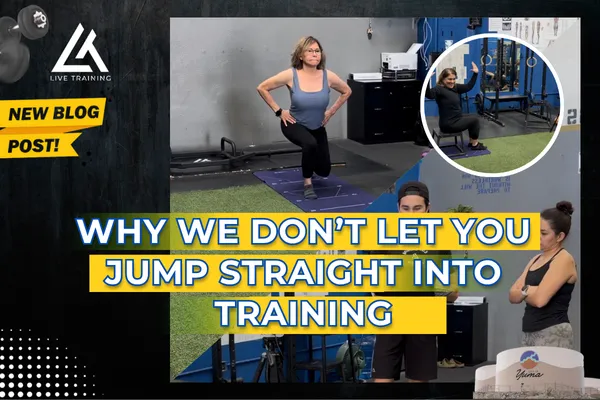
20. Why We Don’t Let You Jump Straight Into Training
Why We Don’t Let You Jump Straight Into Training
Inside the two-week Body Mapping Phase and why it’s the most important thing we’ll ever do together.
──────────────────────────────────────────────────
Most gyms hand you a program on day one and say “let’s go.”
We don’t.
When you start at Live Training, the first two weeks look different than what you might expect. There’s no heavy lifting. No circuits. No “let’s see what you’re made of” test. Instead, there’s something far more valuable: a process we call the Body Mapping Phase.
It’s two weeks of intentional, focused work where we learn everything we need to know about your body—what moves well, what doesn’t, where the pain is hiding, and which muscles have quietly checked out on you. It’s the foundation that everything else gets built on.
And honestly? It’s the reason our members get results that actually last.
What the Body Mapping Phase Actually Is
The Body Mapping Phase—we call it the BMP—is your first two weeks in the LIFT program. Think of it as a diagnostic period. Not a test. Not a tryout. A deep, hands-on process where we map out exactly what’s going on with your body before we ever ask it to perform.
During these two weeks, we’re looking at everything:
Where your pain is and where it's actually coming from. The spot that hurts is rarely the whole story. A painful knee might be caused by a weak hip. A stiff lower back might be driven by locked-up hip flexors. We dig into the root cause, not just the symptom.
Which muscles are doing their job and which ones have gone quiet. Over years of sitting, compensating, and avoiding painful movements, certain muscles stop firing the way they should. We find those weak links before they become bigger problems.
How your body moves as a system. It’s not just about individual muscles. It’s about how everything works together—your ankles, knees, hips, spine, and shoulders all talk to each other. We need to hear the whole conversation.
What you can handle right now and what needs to be earned. We’re not going to throw you into movements your body isn’t ready for. We meet you where you are and build a path from there.
By the end of these two weeks, we have a complete picture. And that picture becomes the blueprint for everything that follows.
Why This Matters More Than Any Workout
Here’s what happens at most gyms: you walk in, someone gives you a generic program, and you start lifting. Maybe it feels fine for a few weeks. Maybe your knee starts bothering you but you push through. Maybe your shoulder flares up and you “just avoid overhead stuff.” Maybe your back tightens up and you stop going altogether.
That’s not coaching. That’s guessing. And guessing with someone’s body is how people get hurt, lose trust, and eventually quit.
The BMP exists because we refuse to guess. We’re not interested in giving you a hard workout on day one to make you feel like you got your money’s worth. We’re interested in building something that lasts—and that starts with understanding the body that’s going to do the work.
It’s impossible to build real strength and real muscle on top of a foundation that’s cracked. Pain, weakness, and imbalance are cracks in the foundation. We fix those first. Then we build.
Alma’s Story: Knee Pain Gone on Day One
When Alma came in, her knee pain was the first thing she told me about. It had been with her for a while—the kind of thing that makes you think twice about stairs, about walking too far, about whether exercise is even safe anymore.
At most places, they would have worked around it. Avoided certain movements. Told her to “listen to her body” and hope it figured itself out.
We tackled it on day one.
We identified the small, stabilizing muscles around her knee that had weakened over time. Specifically her Tibialis Anterior. Muscles that weren’t doing their job—leaving her knee to absorb forces it was never meant to handle alone. We started strengthening those muscles immediately. Targeted, intentional work. Not random exercises. Specific movements chosen because of what her body told us it needed.
The result? Her knee pain started clearing up right away. And once that pain was no longer running the show, we could start building real strength on top of a foundation that could actually support it.
That’s what the BMP is designed to do. Find the problem. Solve it. Then build.
Liz’s Story: The Knee Pain That Wasn’t Really About Her Knee
Liz came in with knee pain too—but hers had a completely different source than Alma’s. Same symptom. Different root cause. And that’s exactly why generic programs fail.
During her first two weeks, we discovered that Liz’s inner thigh muscles—her adductors—and her hamstrings were extremely weak. Those muscles play a critical role in stabilizing the knee, and hers had quietly checked out. Her knee was taking on stress it was never designed to carry because the muscles around it weren’t pulling their weight.
So we went to work. Opening up and strengthening the adductors. Rebuilding the hamstrings. Restoring the support system her knee had been missing.
We found all of this in the first two weeks. Not month three. Not after an injury. In the BMP—exactly when and where it was supposed to be found.
Two members. Same complaint. Two completely different solutions. That’s why cookie-cutter programs will never get this right.
Morgan’s Story: The Elbow That Kept Locking Up
Morgan’s situation looked different from the outside. She wasn’t dealing with knee pain. She came in with tennis elbow, low back issues, and some hip discomfort that’s still a work in progress.
But the tennis elbow told us everything we needed to know about why the BMP exists.
In those first sessions, we’d do a couple of movements and her elbow would start heating up. It would get warm, then tight, and then it would lock up on her—her arm wouldn’t want to close. She couldn’t grip. She couldn’t finish the movement. Her body was sending a clear signal: something isn’t strong enough to handle this.
The answer wasn’t to avoid upper body work. It was to strengthen the muscles that were causing the problem—her forearms and her wrists. Those small muscles were so weak that her elbow was absorbing all the stress every time she gripped or pulled anything.
We spent those first two weeks rebuilding that foundation. Strengthening the forearms. Building wrist stability. Giving her elbow the support system it had been missing.
And the tennis elbow? It hasn’t come back.
That’s not a coincidence. That’s what happens when you find the root cause before you start stacking workouts on top of it.
Why We Can't Skip This Step
I know what you might be thinking: “Two weeks before I even really start training? Can’t we just get to it?”
I get the impatience. You’re ready to work. You’re motivated. You want to feel the burn and see the progress.
But here’s what I’ve learned after working with hundreds of people: the ones who skip the foundation are the ones who end up hurt, frustrated, or gone within three months. The ones who invest in these two weeks are the ones who are still here a year later—stronger, pain-free, and building on top of something solid.
Think about it like building a house. You wouldn’t pour the walls before you checked the foundation for cracks. You wouldn’t hang drywall over a frame that’s uneven. But that’s exactly what most fitness programs do—they stack workouts on top of bodies that aren’t ready for them. And then they blame the person when something breaks.
We do it the other way around. We check the foundation first. We fix the cracks. We make sure everything is level. And then we build—with confidence, with intention, and with a body that’s actually prepared for what’s coming next.
What Happens After the Two Weeks
Once the BMP is complete, we don’t just move on and forget about it. Everything we learned becomes the blueprint for your ongoing program.
If we found weak adductors, those muscles stay in the rotation. If we identified a grip strength issue, we keep building on it. If your hip mobility needs ongoing work, it’s baked into your warm-up every session.
But here’s the exciting part: once the pain is addressed and the weak links are strengthened, we get to the fun stuff. Building real strength. Adding real muscle. Progressing into movements that challenge you in ways that feel rewarding instead of painful.
The BMP doesn’t slow you down. It fast-tracks your growth—because we’re not spending months guessing, backtracking, or working around problems we should have caught on day one.
It’s all about intentionality. Every movement has a purpose. Every session builds on the last. And the foundation we laid in those first two weeks is what makes all of it possible.
You Have a Whole Life Ahead of You
Your body has been telling you things for years. The knee that aches. The back that tightens. The elbow that locks up. Those aren’t signs to stop. They’re signals that something needs attention.
The Body Mapping Phase is how we listen. And once we hear what your body is saying, we know exactly how to help it move, strengthen, and grow—without pain getting in the way.
That’s the difference between a place that gives you a workout and a place that actually understands your body. And it all starts in the first two weeks.
──────────────────────────────────────────────────
Curious What Your Body Would Tell Us in Two Weeks?
If you’re dealing with pain, stiffness, or weakness—or if you’ve been avoiding exercise because you’re not sure what your body can handle—the BMP was built for you.
It all starts with a Starting Point Session. One conversation where we learn about your body, your pain, and your goals. No workout. No pressure. Just a clear picture of where you are and what the first two weeks would look like.
And if it’s not a fit? We’ll shake hands and part friends.
Because the best program in the world means nothing without the right foundation underneath it.
