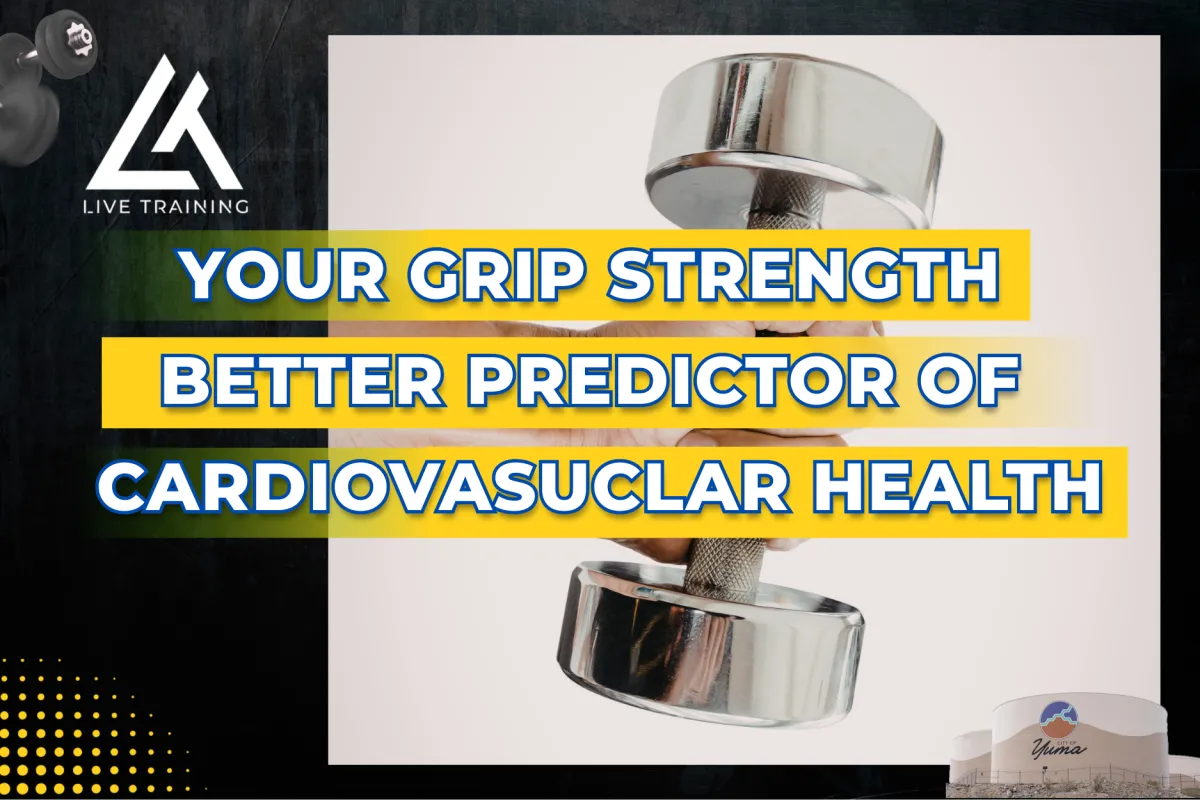
8. Why Grip Strength Matters More Than You Think (And What It Says About Your Health)
Why Grip Strength Matters More Than You Think (And What It Says About Your Health)
Most people think grip strength is about forearms.
It’s not.
Grip strength is one of the strongest indicators we have for overall strength, mobility, nervous system health, and even long-term health outcomes. In fact, researchers have found grip strength to be a better predictor of functional decline than many traditional health markers.
Yet it’s rarely trained intentionally.
At Live Training Yuma, grip strength isn’t an accessory — it’s a signal. And when it’s weak, it often explains why other things feel unstable, painful, or limited.
Grip Strength Is a Window Into the Whole Body
Your hands are deeply connected to your nervous system.
When grip strength is strong and responsive, it tells us:
The nervous system is communicating efficiently
The shoulders and upper back can stabilize
The core can brace effectively
The body can transfer force safely
When grip strength is weak or fatigues quickly, we often see:
Shoulder or elbow pain
Poor posture
Core instability
Difficulty carrying loads
Faster overall fatigue
Grip isn’t just about holding on — it’s about control.
The Real-Life Test Most People Fail
Here’s a simple reality check:
If carrying groceries, luggage, or a heavy bag strains your hands, forearms, or shoulders — that’s not “normal aging.”
That’s a signal.
Grip strength plays a major role in everyday tasks:
Carrying groceries
Holding onto railings
Picking up objects safely
Preventing falls
Maintaining independence as we age
Weak grip often forces other joints to compensate — especially the shoulders, neck, and low back.
That’s where pain begins.
Grip Strength and Long-Term Health
Grip strength has been widely studied as a predictor of:
Overall strength levels
Functional independence
Injury risk
Recovery capacity
It’s one of the simplest ways to assess whether someone can produce and control force.
This is why we include carry assessments and grip-based movements early in our evaluation process. They show us how well the body organizes itself under load — not just how much weight someone can lift once.
Why Most Training Programs Miss This
Most gym programs focus on:
Machines
Fixed grips
Straps too early
Isolated muscle work
All of which remove the demand from the hands.
When grip is removed from the equation, the nervous system stops fully engaging the rest of the body. Strength becomes segmented instead of integrated.
That’s why people can “train hard” and still feel fragile.
How We Train Grip the Right Way
At Live Training Yuma, grip strength is trained indirectly and intentionally.
We use movements that challenge the hands while reinforcing:
Posture
Core stability
Shoulder alignment
Controlled breathing
Examples include:
Loaded carries
Hanging and support work (when appropriate)
Dumbbell and kettlebell variations
Grip-demanding pulls
Not to exhaust the forearms — but to teach the body how to organize itself under load.
Grip Strength and Pain-Free Movement
Strong grip improves:
Shoulder stability
Elbow health
Neck tension
Core engagement
It’s one of the fastest ways to improve how secure someone feels during movement — especially for adults returning to training after pain or time off.
When grip improves, confidence follows.
And when confidence improves, movement quality improves.
The Bigger Picture
Grip strength isn’t about squeezing harder.
It’s about creating a stable connection between your body and the world around you.
When that connection is strong:
Movement feels safer
Load feels manageable
Strength transfers to real life
That’s why we pay attention to it — and why we train it with intention.
Because strength that doesn’t carry over to life isn’t strength at all.
Want to Go Deeper?
If you’re curious how grip strength fits into a personalized, pain-free training approach, this is exactly the kind of thing we evaluate during your Starting Point Consultation.
Grip is just one signal — but it tells a powerful story about how your body moves, adapts, and ages.
