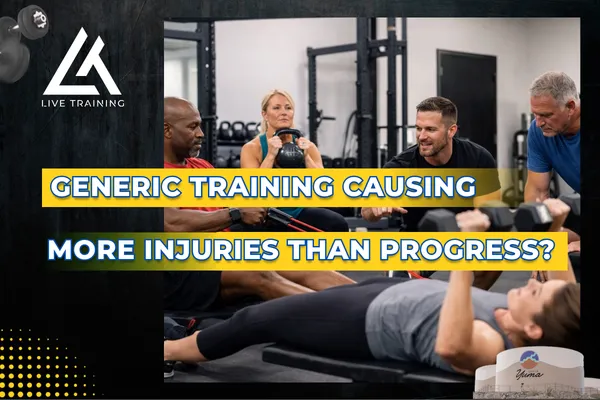
6. Why Generic Training Causes More Injuries Than Progress
Generic training causes more injuries than progress.
Walk into most open gyms in Yuma and you’ll see it immediately — people cranking through movements with no real plan, no evaluation, and no trained eyes on their form.
The result is almost always the same:
Nagging low-back pain
Sore or unstable knees
Shoulder and neck tension
Workouts that create more problems than solutions
Most of these people aren’t lazy.
They’re not weak.
They’re simply following systems that were never designed for their body.
The Real Problem With “Just Start Working Out”
Most training programs skip the most important step: understanding how someone moves before loading them.
Instead, people are handed:
A generic workout
A rushed consult
Or a template pulled off a screen
Those programs might tell you what to do — but they never explain:
How your joints actually work together
Where you’re compensating
Or why certain movements don’t feel right
Pain isn’t random.
It’s information.
And if no one is listening to it, the body eventually forces the issue.
Why We Evaluate Before Prescribing Anything
At Live Training Yuma, we don’t prescribe a single exercise until a certified professional evaluates how your body moves first.
We intentionally slow down the beginning of your journey with a two-week pain-free movement evaluation.
Not to hold you back — but to build you forward.
During those two weeks, we coach, observe, and score you through 24 different movement patterns, allowing us to clearly see:
Where you’re strong
Where you’re vulnerable
What your body actually needs
We don’t just watch you move once.
We see how your body reacts to:
Basic stability drills
Functional strength work
Different loads
Different positions
That’s how we remove guesswork.
This Is How We Build Your Plan From the Ground Up
Your program is not built from a template.
It’s built from your movement story.
Alongside those coached sessions, we run five advanced assessments that reveal how your body balances, stabilizes, and transfers force under real-world demands.
These assessments don’t label you — they guide decisions.
1. Single-Leg Balance: Your Foundation for Joint Safety
We assess how your ankle, hip, and core work together when all your weight is on one side.
Why it matters:
Balance is joint safety.
If the knee collapses, the foot rolls, or the torso shifts, it tells us the foundation needs attention before load increases.
This helps us:
Improve stability
Build confidence under load
Reduce fall risk as we age
Strong balance today means safer movement tomorrow.
2. Lunge & Lower-Body Control: How You Share the Load
Next, we assess how your legs work together — or don’t.
If one side dominates, the other side eventually pays for it.
For example:
If the back knee collapses
Or the front hip locks up
We may start with supported split squats before progressing to heavier or dynamic lunges.
This allows us to build hip and core control first, so strength doesn’t come at the expense of joint health.
3. Push Assessment: Shoulder Alignment Under Load
Pressing movements tell us a lot about shoulder health.
We’re not just watching the arms — we’re watching:
Shoulder position
Rib cage control
How force travels through the torso
If one shoulder shifts forward during a push-up or press, that’s valuable information.
Instead of pushing through it, we may:
Start with floor presses
Use incline or banded variations
Reduce range temporarily
This keeps shoulders strong and pain-free instead of grinding through poor mechanics.
4. Pull Assessment: Posture and Upper-Back Support
Pulling patterns reveal how well your upper back supports your posture.
Why this matters:
Most adults are tight in the front and under-supported in the back.
If we catch this early, we can choose:
Row variations
Band pulls
Supported angles
That open the chest, protect the neck, and restore posture — instead of reinforcing tension.
5. Hip Mobility & Hinge Patterns: Protecting the Low Back
Your hips are the hinge of almost everything:
Walking.
Squatting.
Bending.
Lifting.
If the hips can’t move freely, the low back pays the price.
We assess hip mobility and hinge mechanics using multiple strategies:
Active straight-leg raises
External cues like bands for core engagement
Foam roller squeezes to activate adductors
These aren’t “fixes” — they’re information tools that tell us how your body organizes movement.
That information dictates:
How deep you squat
When you hinge
How quickly we introduce load
No Guesswork. No Random Workouts.
By the end of the two-week evaluation:
You already feel stronger
Movement feels smoother
Confidence replaces fear
And we know exactly what makes your body feel safe, stable, and powerful.
From there:
Every rep is coached
Every exercise is adjusted
Every movement is personalized
Strength-Based Therapy in Action
Within the first two weeks alone, we’ve helped members solve, improve, or prevent:
Tennis elbow
Post–knee surgery stiffness
Scoliosis-related imbalances
Sciatic nerve pain
Chronic low-back pain
Persistent knee pain
Not through rest.
Not through avoidance.
But through intelligent, personalized strength training.
Why This Matters Long Term
That’s why so many people in Yuma trust us.
We don’t just train bodies.
We teach people how to move without pain first — so training becomes something they can do for decades, not just a few motivated weeks.
And when movement feels safe again, everything else finally works.
