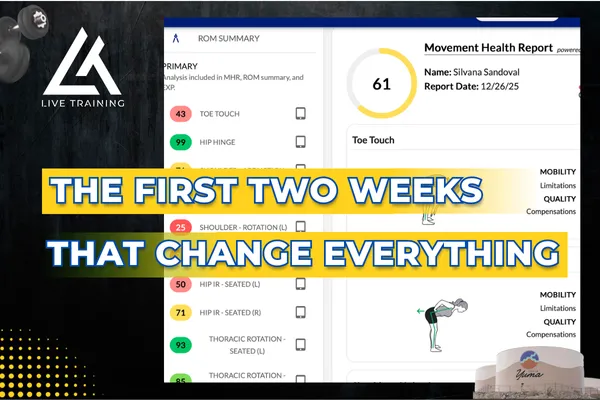
4. The First Two Weeks That Change Everything
Why Most Fitness Assessments Miss the Mark — And Why We Slow the Process Down
Most gyms start the same way.
You’re handed a cookie-cutter plan or rushed through a 10–15 minute consultation.
Maybe they check your weight.
Maybe they watch you squat once.
Then you’re sent on your way with a workout and a diet that basically says:
“Eat less. Move more. You’ll figure it out.”
Those basic assessments might tell someonewhatyou can do in that moment.
But they don’t tell us:
How you move
Why certain things feel off
Or what’s actually contributing to pain, stiffness, or inconsistency
And when it comes to nutrition, it often gets worse — rigid plans that demand immediate compliance with zero context, zero personalization, and zero consideration for real life.
It works… briefly.
Until motivation fades.
Until life gets busy.
Until the plan doesn’t bend — and eventually breaks.
Then people assume they failed.
They didn’t.
The system did.
The Problem With Rushed Assessments and One-Size-Fits-All Plans
Fad diets and generic programs don’t fail because people are lazy.
They fail because they demand overnight change.
They force compliance instead of understanding.
They prioritize speed over clarity.
They treat bodies like templates instead of individuals.
Life doesn’t stop for a plan.
And when a plan can’t adapt to stress, sleep, pain, or recovery — it becomes unsustainable.
That’s why we do things differently.
Why We Slow the Process Down at Live Training Yuma
At Live Training Yuma, we don’t rush the start of your training journey.
We slow it down on purpose.
Before you ever touch a barbell or follow a long-term program, we take you through a two-week evaluation process designed to understand how your body moves, feels, and responds.
Most people don’t realize how different this is — until they experience it.
Over those two weeks, we don’t just test.
Weobserve, coach, and adjust, all while helping you feel comfortable and confident in the gym again.
What We Actually Look At (And Why It Matters)
During your evaluation phase, we assess far more than strength numbers.
We look at:
24 foundational movement patterns (squat, hinge, lunge, push, pull, carry, rotation)
Advanced shoulder stability
Advanced hip mobility
Posture and carry mechanics
Baseline strength levels
How your body responds to training and recovery over time
This tells us:
Where you’re strong
Where you’re compensating
Where risk may show up later if ignored
And how to progress you safely without guessing
It’s not about passing or failing.
It’s about learning your body.
Why This Approach Works Better Long Term
Forced change rarely lasts.
Sustainable change happens when a method can grow with you— adjusting to your strengths, limitations, stress levels, and life demands.
When we learn your body— not a textbook version of it — we can:
Reduce unnecessary pain and flare-ups
Build confidence instead of fear
Progress strength intelligently
Create plans that adapt instead of collapse
That’s how we outperform quick fixes.
Not by doing more — but by doing what actually matters.
It’s About More Than How Much You Can Lift
Progress isn’t just a number on a bar.
It’s:
How well you move
How aware you are of your body
How confident you feel training
And how prepared you are for thenextphase of strength
When training starts with understanding instead of assumptions, results don’t just come faster — they last longer.
That’s the difference between another cycle…
and a system that finally works with you.
